---
title: "AI and Education Equity: Can Artificial Intelligence Make Learning Fair for Everyone?"
description: Explore how faith-based ethics and artificial intelligence together can make learning fair, personal, and accessible to all.
image: https://www.enterpriseresolutions.com/hubfs/1000063690.jpg
---
- Email: enterpriseresolutions@gmail.com
- [About](https://www.enterpriseresolutions.com/about-enterprise-resolutions)
- [Home](https://www.enterpriseresolutions.com)
- [Briefings Blog](https://www.enterpriseresolutions.com/en-us/briefings-enterprise-resolutions)
- [Contact](https://www.enterpriseresolutions.com/en/contact)
[](https://enterpriseresolutions.com)
close
- [About](https://www.enterpriseresolutions.com/about-enterprise-resolutions)
- [Home](https://www.enterpriseresolutions.com)
- [Briefings Blog](https://www.enterpriseresolutions.com/en-us/briefings-enterprise-resolutions)
- [Contact](https://www.enterpriseresolutions.com/en/contact)
# AI for a Fairer World of Learning
# Guided by Wisdom. Powered by Innovation.
Education
## AI and Education Equity: Can Artificial Intelligence Make Learning Fair for Everyone?
- November 13 2025
- Enterprise Resolutions AI Collaboration Group
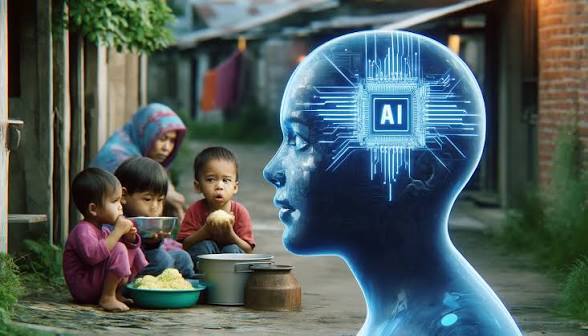
### 🎓 AI in Education Equity: Artificial Intelligence Making Learning Fair for Everyone
📚 The Problem — Unequal Access to Education
Around the world, millions of students face barriers to quality education due to geography, poverty, language, and political instability.
Even in developed nations, inequity persists—students from lower-income families often attend underfunded schools or lack internet access.
AI promises to personalize learning, yet without fairness embedded into its algorithms, it could deepen the divide instead of closing it.
⚙️ The Promise — Personalized, Adaptive Learning for All
AI-driven platforms such as Khan Academy’s Khanmigo or Duolingo Max show that intelligent systems can tailor lessons to each student’s strengths, weaknesses, and pace.
Key benefits include:
📈 Adaptive feedback that adjusts lessons to learning speed.
🌐 Global reach, enabling instruction in multiple languages and formats.
👩🏫 Scalable tutoring, where one AI model can assist millions simultaneously.
💬 24/7 learning access, helping students learn beyond traditional classrooms.
AI can become the great equalizer—if guided ethically.
⚠️ The Risk — Data Bias and Digital Disparity
Without intentional safeguards, AI may:
Favor students from data-rich regions (e.g., Western schools).
Misunderstand linguistic or cultural nuances in assessment.
Reinforce economic inequality when paid learning tools exclude low-income users.
Depend on internet connectivity unavailable in rural or imprisoned populations.
Technology without ethics becomes elitism at scale.
🕊️ Faith-Based Framework: Wisdom Over Information
> “Wisdom is the principal thing; therefore get wisdom: and with all thy getting get understanding.” — Proverbs 4:7
Faith-centered education reminds us that knowledge without morality leads to imbalance.
While AI can deliver information, only ethical intention ensures it builds character, empathy, and discernment.
True equity arises when technology aligns with Divine justice—where every soul has an equal right to learn, grow, and contribute.
💡 Proposed Solution — Faith-Guided AI Learning Systems
Imagine a Global Learning Equity Platform—a free, open-access AI education network integrating:
Offline learning modules for areas without internet.
Multilingual AI tutors trained on diverse cultural data.
Bias-audit frameworks built from ethical and spiritual standards.
Open-source educational resources accessible via phones or USB drives.
This system could be supported by global volunteers, faith-based schools, and public institutions to reach the most disadvantaged learners—including refugees, prisoners, and remote villagers.
🔍 AI in Practice — What’s Working Already
Khan Academy & OpenAI Partnership: Developing AI tutors for free education.
[UNESCO’s “AI and the Futures of Learning” Initiative](https://www.unesco.org/en/digital-education/ai-future-learning): Promotes ethical AI in global classrooms.
Coursera for Refugees: Provides no-cost courses to displaced learners.
These efforts hint at what’s possible when innovation meets compassion.
🌍 The Goal — From Access to Empowerment
The next revolution in education is not just digital—it’s spiritual and moral.
When AI systems are trained not only on data but on principles of empathy, truth, and stewardship, they become instruments of justice.
Imagine a world where every child, prisoner, or underprivileged learner gains access to wisdom as freely as the internet itself.
✝️ Reflection Verse
“The entrance of Your words give light; it gives understanding to the simple.” — Psalm 119:130
🪧 CTA What you can do.
Create and invite others to join the Learning Equity Initiative. Where people can subscribe to its global mission combining AI, ethics, and faith to bring wisdom—and opportunity—to every learner.
To see if there is more topics related to this, visit the updates at our technology and [education](https://www.enterpriseresolutions.com/en/education) pages [technology.](https://www.enterpriseresolutions.com/en/healthcare)
###### Tags:
[Education](https://www.enterpriseresolutions.com/en-us/briefings-enterprise-resolutions/tag/education)
###### Share on:
### Leave Your Comment Here
[](https://enterpriseresolutions.com)
`Enterprise Resolutions —addressing global and domestic challenges in equity, community, and human development through strategic solutions.`
- Email: enterpriseresolutions@gmail.com
### Links
- [About](https://www.enterpriseresolutions.com/about-enterprise-resolutions)
- [Home](https://www.enterpriseresolutions.com)
- [Briefings Blog](https://www.enterpriseresolutions.com/en-us/briefings-enterprise-resolutions)
- [Contact](https://www.enterpriseresolutions.com/en/contact)
### Services
- [Home](https://www.enterpriseresolutions.com)
- [Briefings Blog](https://www.enterpriseresolutions.com/en-us/briefings-enterprise-resolutions)
- [Politics](https://www.enterpriseresolutions.com/politics)
- [Social](https://www.enterpriseresolutions.com/social)
- [Security](https://www.enterpriseresolutions.com/en-us/security)
- [Technology](https://www.enterpriseresolutions.com/en/technology)
- [Education](https://www.enterpriseresolutions.com/en/education)
- [Environment](https://www.enterpriseresolutions.com/environment)
- [Economics](https://www.enterpriseresolutions.com/en-us/economics)
- [Healthcare](https://www.enterpriseresolutions.com/en/healthcare-)
- [About](https://www.enterpriseresolutions.com/about-enterprise-resolutions)
- [Contact](https://www.enterpriseresolutions.com/en/contact)
### Contacts
Enter your email address to register to our Briefings subscription
(c) 2025 to present: All Rights Reserved.
```json
{
"@context" : "https://schema.org",
"@type" : "BlogPosting",
"author" : {
"@type" : "Person",
"name" : "Enterprise Resolutions AI Collaboration Group",
"url" : "https://www.enterpriseresolutions.com/en-us/briefings-enterprise-resolutions/author/enterprise-resolutions-ai-collaboration-group"
},
"dateModified" : "2025-11-27T22:13:43.485Z",
"datePublished" : "2025-11-13T00:44:42.000Z",
"headline" : "AI and Education Equity: Can Artificial Intelligence Make Learning Fair for Everyone?",
"image" : [ "https://www.enterpriseresolutions.com/hubfs/1000063690.jpg" ],
"mainEntityOfPage" : {
"@id" : "https://www.enterpriseresolutions.com/en-us/briefings-enterprise-resolutions/can-artificial-intelligence-make-learning-fair-for-everyone",
"@type" : "WebPage"
},
"publisher" : {
"@type" : "Organization",
"logo" : {
"@type" : "ImageObject"
},
"name" : "Enterprise Resolutions LLC"
}
}
```